The tangled trees#
What CRM inherited from the subscription list, and what it left behind
G. Righter · ZnuLabs · Copyright © 2022–2026, Grover Righter
Abstract. The customer relationship data model is not designed. It is inherited, and its ancestor is the magazine subscription list. We trace the descent — private post riders, the Postal Acts of 1794 and 1879, the rented mailing file, the business response card — and show that the modern schema retains the acquisition half of that model while having silently dropped the deletion half, which is what made the original work. We then state the structural complaint formally enough to be actionable: the stored schema is a forest of type hierarchies, the world it represents is a connected graph, and the edges that carry the most commercial information are precisely the ones with no column to live in. The formal treatment of the resulting projection is deferred; this note establishes what is being projected and why the shape is what it is.
Keywords: data model lineage, entity hierarchies, list marketing. MSC 05C05. JEL M31, N80.
1. The complaint#
Ask anyone who has used a customer relationship platform in anger what is wrong with it, and the answer arrives without hesitation and in almost identical words: it sees the world in silos. Leads sit in one place, Contacts in another, for reasons nobody can articulate. A tradeshow at which nine people from four companies were met resolves into nine unrelated rows. The question how much of this company do we actually know returns silence rather than an error.
The complaint is correct and the diagnosis attached to it is almost always wrong. Practitioners assume the model was designed badly, by people who did not understand selling, and that a better vendor would have designed it better. Every vendor has now tried. The shape persists across four decades and every competitor, which is the signature of inheritance rather than error.
This note is about the inheritance. It does not fix anything. It establishes what the object is and where it came from, because the shape of the model is not arbitrary and the parts that look like mistakes are mostly load-bearing features of a different business that no longer exists.
THE FERRYMAN // Ο πορθμέας
Two years at this now. I have stopped being surprised by the same complaint in every building.
A man will tell me his system is broken and then describe, in detail, a system that is working exactly as designed. Just not for what he needs.
Nobody built this to do what you are asking of it.
That is not an insult to the people who built it. They built a very good machine for a job that was real in 1993 and is not the job you have now.
You inherited a boat built for a river that has since moved. It is a fine boat. Look at where the water is.
2. The list#
Lists ruled commerce for two hundred years before anything was called a customer relationship system, and the mechanics of the list are visible in every schema shipping today.
In the 1740s, colonial magazine publishers moved their product by private riders and by arrangement with postmasters who were not always disinterested parties. The Postal Act of 1794 admitted magazines to the mail as a legal category and priced them at roughly the cost of the magazine itself, which constrained circulation to those who could pay twice for one object. The Postal Act of 1879 created second-class mail at two cents per pound and detonated the mass-circulation magazine as a business. The subscriber file became an asset with a market price.
That file is the ancestor. The vocabulary descends with it: the lead as a purchased, allocated, and jealously guarded unit of hope is the sales culture Mamet was writing about in 1984, and the word arrives in the schema already carrying that freight.
Its operating cycle had four movements, and the fourth is the one that matters:
- Rent a list — magnetic tape shipped under bond to a mailing house, with seeded decoy addresses to detect unauthorised reuse.
- Mail the campaign — thousands of physical pieces at second-class rates.
- Measure with a business response card — the bound-in reply card, which converted an anonymous mailing into a named respondent.
- Retain only the responders. Purge the rest.
Movement four was not hygiene. It was economics. Every retained name cost money to hold and money to mail, so a name that had not responded was a liability carried at a per-unit cost the publisher could compute exactly. The list stayed clean because storage was expensive and the cleaning paid for itself in the next mailing.
3. The dropped clause#
Sales force automation arrived in 1993 with Siebel Systems, which formalised shared pipelines, forecasting, and territory management into a category. The data model it adopted was the list model, extended with a state machine for the selling process. The lineage is not disputed and was not hidden; it was the obvious thing to build from.
What it did not adopt was movement four.
The reason is banal and worth stating precisely, because it is the origin of almost everything the rest of this series measures. The cost structure inverted. Where holding a name had been a recurring physical expense — paper, postage, weight — it became a negligible marginal cost against a database licence. Deletion stopped paying for itself, and any policy that stops paying for itself stops being enforced. The purge was not debated and rejected. It simply had no advocate.
Observation 3.1 (The inherited half-cycle). The modern schema implements movements 1–3 of the list cycle at very high fidelity and omits movement 4 entirely. Acquisition is instrumented, measured, and compensated; retirement has no owner, no metric, and no budget line.
The consequence is an accumulating store. Records enter and do not leave. This is the precondition for everything that follows in this series, and it is worth being clear that it is not a failure of discipline by any individual operator. It is the predictable result of removing the only clause in the original design that had a deletion policy attached to it, and replacing it with nothing.
THE FERRYMAN // Ο πορθμέας
The old publishers threw names away. Deliberately, every cycle, without sentiment.
They were not tidier than you. They were poorer. Every name they kept cost them paper and postage and a man to carry it, and a name that never wrote back was a hole in the bottom of the boat.
So they bailed. Every crossing. It was not a virtue, it was arithmetic.
Then storage got cheap and the arithmetic went away, and with it the bailing. Nobody voted on this. Nobody stood up and said we shall now keep everything forever regardless of whether it is true.
It just stopped costing anything to be wrong. And so we became wrong at scale, and called it a database.
4. Four trees where there should be a graph#
The structural complaint can now be stated precisely, and it is a statement about shape rather than about quality.
The stored schema is a forest: a disjoint union of type hierarchies. Campaign is a root with members beneath it. Account is a root with contacts and opportunities beneath it. Event is a root with attendees. Lead is a root with nothing beneath it at all — a stub hierarchy of depth one, which is a hint that something has gone wrong. Write $\mathcal{F}$ for this forest.
The world being represented is a graph. Write $G$ for it. Its vertices are human beings and firms. Its edges are the relations that actually carry commercial information: works with, reports to, attended the same meeting as, will decide this jointly with, replaced in the role, left and now works at a prospect. These edges are not exotic. They are the substance of enterprise selling, and every experienced seller carries a mental model of them.
Not one of those edge types has a column.
Figure 1 shows the two objects side by side. The shaded nodes in panel (a) are one human being, occurring four times across four hierarchies with nothing in the schema asserting that the occurrences are the same person.
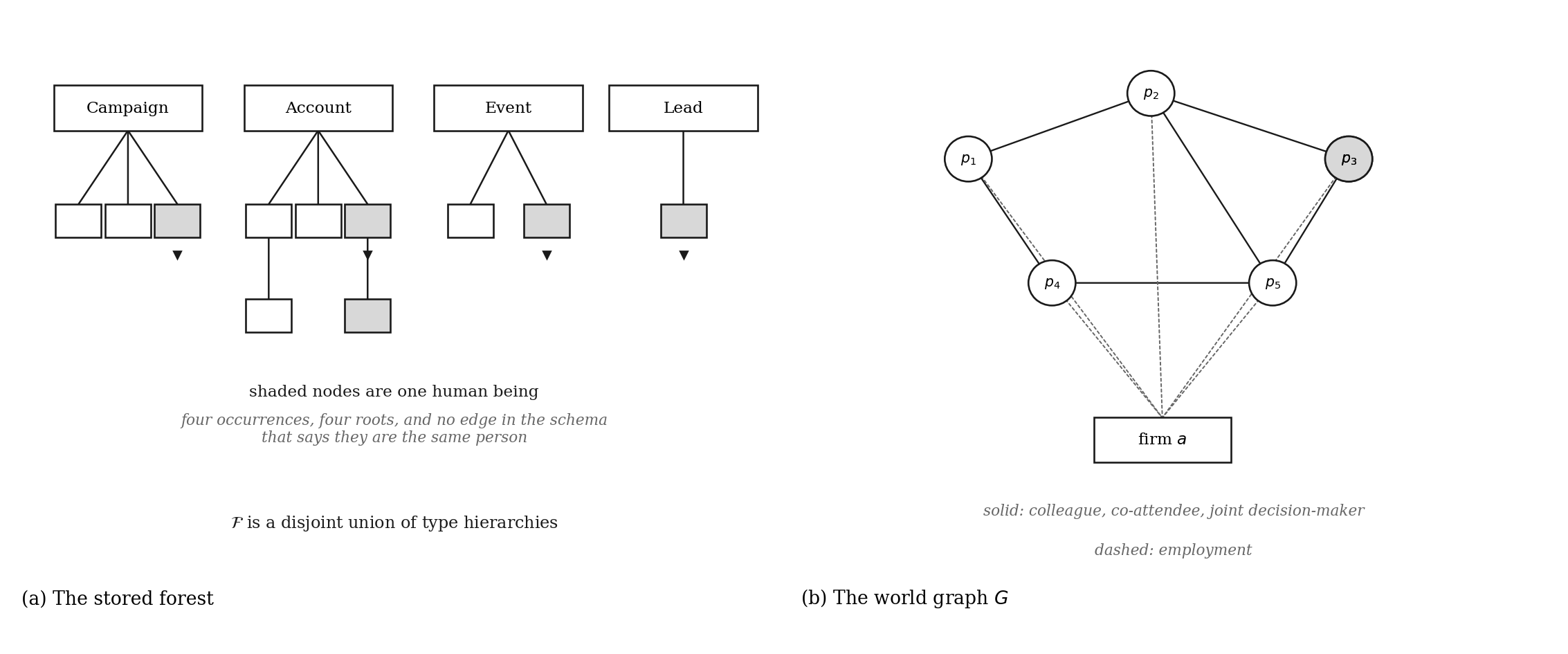
Figure 1. (a) The stored schema as a disjoint union of type hierarchies; the shaded nodes are a single human being appearing four times with no connecting edge. (b) The world the schema represents, in which the same population is one connected object and the informative edges are lateral rather than hierarchical.
Observation 4.1 (Tangling). A forest admits no lateral edges by construction. Every relation in $G$ that is not parent–child must therefore be represented in $\mathcal{F}$ either by duplication of a vertex across hierarchies, or not at all. The duplicates carry no assertion of identity.
This is the tangle, and the name is precise. The trees are not badly drawn. They are trees, and the thing they are drawn from is not one, and the residue of the mismatch is a set of records that look like separate people, separate interactions, separate relationships, because the schema has no way to say otherwise.
Two immediate consequences are worth recording, because both are usually attributed to poor data entry.
Duplicates are structural, not clerical. When the same person is a Lead from a webinar, a Contact at an account, an attendee at a tradeshow, and a member of a campaign, the schema has done exactly what it was built to do. Deduplication tooling addresses the symptom. The generator is the forest.
The Lead/Contact division is not a distinction of kind. It is a statement about whether a link to an Account happens to exist. Both are people. One has a parent in the Account hierarchy and one does not, and the platform exposes that as though it were a difference in the nature of the record. It is not. The formal version of this claim is deferred to the next note, where it turns out to be a one-line consequence rather than an argument.
5. Interactions do not have a natural home#
The forest also has no natural place to put an interaction, and the workarounds are visible in every schema.
An interaction is not owned by any one hierarchy. A meeting between three people from a prospect and two from the seller belongs to the people, to both firms, to the opportunity it advances, and to the event it occurred within. A forest requires a single parent. So the platform picks one, and the choice is essentially arbitrary — usually the person, occasionally the account — and the remaining relations are dropped or reconstructed by convention.
Interactions divide naturally along two independent axes, which the industry vocabulary conflates badly.
| Class | Participants | Firms represented | Instance |
|---|---|---|---|
| Individual | one | one | a call, a one-to-one meeting |
| Group | several | one | a multi-stakeholder meeting at one account |
| Collective | several | several | a tradeshow, a roundtable, a webinar |
Table 1. Interaction classes by participant count and firm multiplicity.
A fourth term is in common use — additive interaction, meaning many unrelated one-to-one contacts — and it does not belong in this table. It describes a collection of individual interactions rather than a class of interaction, and including it is what makes the taxonomy feel unstable when practitioners try to apply it. Demoting it to an aggregation leaves three classes cleanly separated by two binary questions.
The commercially important observation is that the forest can represent the first row and not the other two. A group meeting decomposes into individual rows; a collective event decomposes into individual rows; and once decomposed, nothing distinguishes the decomposition from a set of unrelated calls that happened on the same afternoon. Whether that loss is recoverable is a formal question and is treated in the next note.
THE FERRYMAN // Ο πορθμέας
Here is what I cannot stop noticing.
The thing every good seller actually knows — that the quiet one in the corner is the one who decides, that these two used to work together at the last firm, that the meeting where all five of them showed up meant something the four calls before it did not — none of it is written down anywhere.
It lives in one person’s head. It leaves when they leave.
We built a system of record that does not record the thing.
And then we are surprised when a territory changes hands and the new man starts from nothing, holding a list of names in a database that has been diligently maintained and tells him almost nothing he needs.
6. What this note establishes, and what it does not#
Three things are settled.
The shape is inherited rather than designed, from the subscription list, and the inheritance is partial: the acquisition cycle survived and the deletion clause did not. The stored schema is a forest and the world is a graph, so lateral relations have no representation and appear instead as unlinked duplicates. And interactions above the one-to-one case have no home in a forest, so they are stored decomposed.
Four things are not settled, and each becomes a subsequent note.
Whether the decomposition of a group interaction is recoverable — whether one can reconstruct the meeting from the rows it became — is a formal question about a projection, and it has a definite answer that is not the optimistic one. Whether the coverage of an account can be measured, given that the schema cannot say how many people matter, requires an estimator borrowed from a field with no commercial connection to this one. Why a particular deal was won or lost, which is the question all of this is ultimately in service of, turns out to be partly unanswerable in a way that can be stated precisely. And what happens to all of these records as the world they describe moves on without them is a matter of rates rather than structure, and needs a different kind of mathematics altogether.
This note supplies only the object and its provenance. That is deliberate. A great deal of confused argument about customer data proceeds from the assumption that the schema is a neutral container that somebody filled in badly, and almost every practical conclusion changes once it is understood as a two-hundred-year-old list model with its cleaning clause removed and a forest imposed on a graph.
THE FERRYMAN // Ο πορθμέας
So: a boat built for a different river, missing the bailing bucket, with the cargo stacked in four piles that do not know about each other.
That is the honest inventory. I have not fixed anything today.
But I have stopped calling it broken, and that is worth something.
A broken thing you replace. An inherited thing you understand first, because the parts that look stupid are usually load-bearing and the parts that look harmless are usually where the water comes in.
Next I want to know something harder. When five people sat in that room and the system wrote down five separate lines — is the meeting still in there somewhere, if you know how to look?
I suspect not. I would like to be wrong. We will find out properly.
References#
Diestel, R. (2017). Graph Theory, 5th ed. Springer, Berlin. Ch. 1, for the forest/graph definitions used in Section 4; nothing beyond them is required.
John, R. R. (1995). Spreading the News: The American Postal System from Franklin to Morse. Harvard University Press, Cambridge MA.
Mamet, D. (1984). Glengarry Glen Ross. Methuen, London.
Postal Act of 1794, 1 Stat. 354. Postal Act of 3 March 1879, 20 Stat. 355, establishing second-class mail matter.
Siebel, T. M. and House, P. (1999). Cyber Rules: Strategies for Excelling at E-Business. Currency Doubleday, New York. Cited for the author’s own account of the category’s origin rather than for its forecasts.